Kanban Panel
The Kanban panel provides a visual ticket board for managing work with the tk ticket system. Tickets are stored as markdown files in the project’s .tickets/ directory (via the github.com/radutopala/ticket
library) and shared between the CLI (tk), agents, and the Kanban UI.
Related docs: HTTP API — Tickets | Events System | Layouts | Multi-Agent
Overview
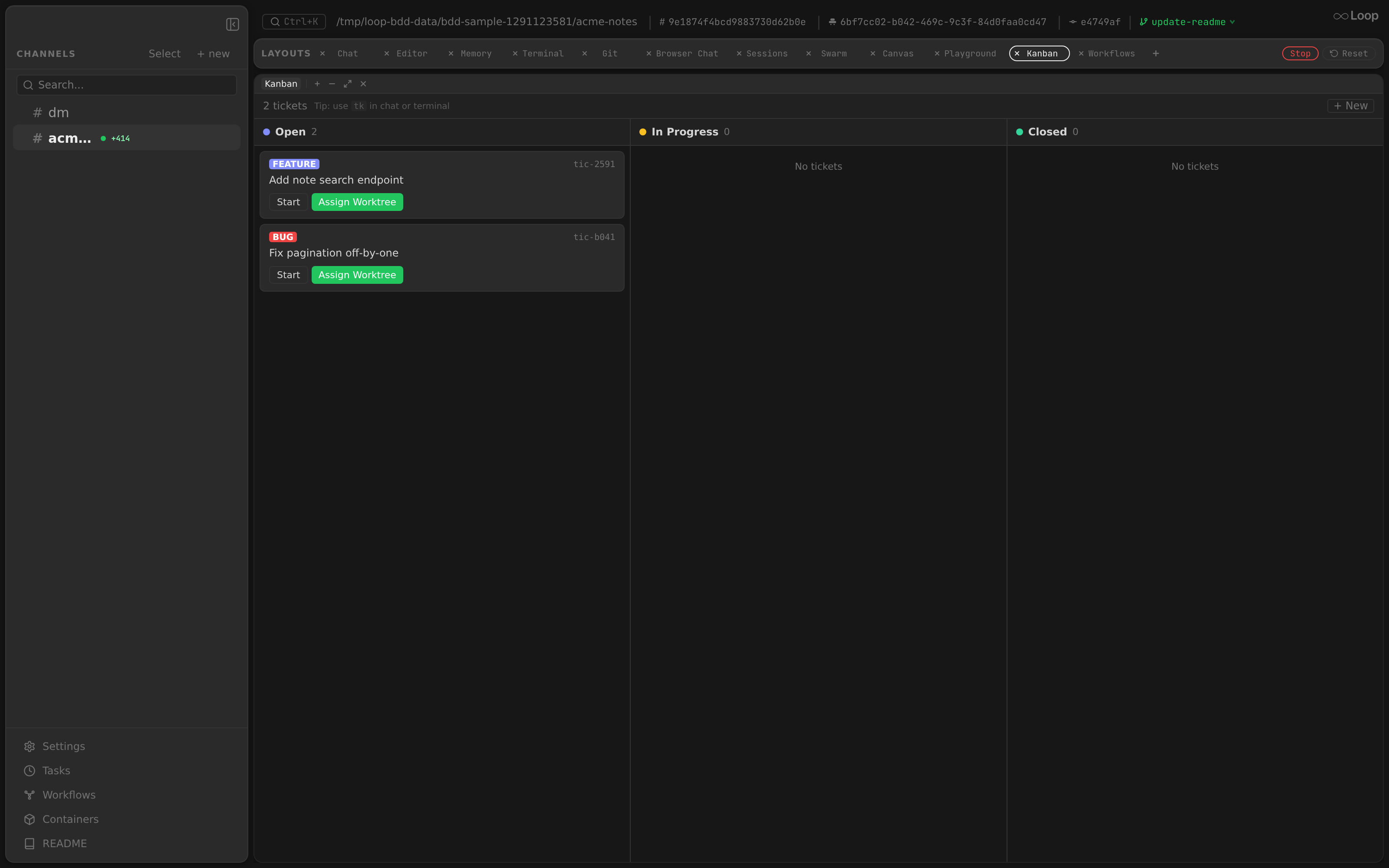
The panel displays three status columns — Open, In Progress, and Closed — each showing ticket cards sorted by priority. Tickets flow left to right as work progresses.
┌──────────────┬──────────────────┬──────────────┐
│     Open     │   In Progress    │    Closed    │
├──────────────┼──────────────────┼──────────────┤
│  P0 bug      │  P1 feature      │  P2 task     │
│  P1 feature  │  P2 task         │              │
│  P3 task     │                  │              │
└──────────────┴──────────────────┴──────────────┘
The panel is a singleton (one per layout) and channel-only (hidden in threads and worktrees, since tickets belong to the parent project). Live updates arrive via WebSocket events (ticket.created, ticket.updated, ticket.deleted, channel.created).
Ticket Cards
Each card displays:
| Element | Description |
|---|---|
| Priority badge | P0–P4, highlighted red for P0–P1 |
| Type tag | bug, feature, task, epic, chore — color-coded |
| Ticket ID | Short ID (e.g., tic-a1b2) |
| Title | Clickable — opens the edit modal |
| Tags | Comma-separated list |
| Assignee | Shown when set |
| External ref | Shown when set. If the value starts with http:// or https:// it renders as an underlined link that opens in a new tab (target="_blank"); otherwise it’s plain monospace text. The click is stopPropagation’d so it doesn’t open the edit modal. |
| Pull request | Same rendering as External ref — clickable link when the value is a URL, plain text otherwise. Set via the pr field on the ticket; surfaced in both the create and edit modals’ “More fields” section. |
| Dependency count | Shown when the ticket has dependencies |
Status Actions
| Status | Available Actions |
|---|---|
| Open | Start (move to In Progress), Assign Worktree (create worktree + agent) |
| In Progress | Close, Reopen |
| Closed | Reopen |
Create Ticket
Click "+ New" in the panel header to open the create modal.
Required Fields
| Field | Description |
|---|---|
| Title | Ticket title (required) |
Optional Fields
| Field | Description |
|---|---|
| Type | task (default), bug, feature, epic, chore |
| Priority | P0–P4 (default: P2) |
| Description | Markdown description |
| Assignee | Free-text assignee name |
| Tags | Comma-separated tags |
Advanced Fields (collapsible “More fields” section)
| Field | Description |
|---|---|
| External Ref | Link to an external issue tracker (Jira, GitHub, etc.). Rendered as a clickable link on the card when the value is an http(s) URL. |
| Pull Request | URL of the PR backing this ticket. Rendered as a clickable link on the card when the value is an http(s) URL. |
| Parent | Parent ticket ID for sub-task relationships |
| Design | Design notes (markdown) |
| Acceptance | Acceptance criteria (markdown) |
Modal Sizing
The create and edit modals are sized for serious editing rather than quick capture: width: 70vw, minWidth: 600, maxWidth: 1200, with maxHeight: 90vh and internal scroll for overflowing content. The description textarea is 6 rows; design and acceptance textareas are 5 rows. Backdrop-click outside the modal cancels without saving (form state is preserved in the draft autosave).
Draft form state auto-persists to localStorage per channel under the key kanban-draft:{channelId}, so in-progress ticket creation survives page reloads and panel switches. The draft is cleared on save and on explicit cancel-with-empty-form.
Edit Ticket
Click a ticket’s title to open the edit modal. All fields from the create form are editable, plus:
| Field | Description |
|---|---|
| Dependencies | Comma-separated ticket IDs that must close before this ticket becomes ready |
The edit modal also includes an inline Delete button with “Delete? Yes / No” confirmation.
Assign Worktree
The “Assign Worktree” button on open tickets is the key integration between tickets and agents. It performs these steps atomically:
- Claim — transitions the ticket from
opentoin_progressusing an atomic file lock (store.AtomicClaim) - Detect base branch — resolves the current branch of the parent project
- Create worktree — creates a git worktree on a new branch (
tk-<ticket-id>) based on the current branch - Create thread — spawns a new thread named after the ticket title
- Set assignee — writes the thread name as the ticket’s assignee
- Start agent — sends the ticket description as the initial message, auto-starting an agent in the worktree
After assignment, the ticket moves to the “In Progress” column and a new worktree thread appears in the sidebar.
The “Assign Worktree” button is only enabled in parent channels (not in threads or existing worktrees).
Filesystem Storage
Tickets are stored in .tickets/ inside the project directory as individual markdown files. This means:
- Git-trackable — tickets can be committed, branched, and merged alongside code
- Shared — the
tkCLI, agents, and the Kanban UI all read/write the same files - No database — no server-side state beyond the filesystem
The ticket library (github.com/radutopala/ticket/pkg/ticket) handles file I/O, ID generation, status transitions, dependency validation, and atomic operations.
Relationship to tk CLI
The Kanban panel and the tk CLI are two interfaces to the same ticket store:
| Operation | Kanban UI | tk CLI |
|---|---|---|
| List tickets | Panel columns | tk list |
| Create | “+ New” button | tk create "title" |
| Start work | “Start” button | tk start <id> |
| Close | “Close” button | tk close <id> |
| Assign worktree | “Assign Worktree” button | Manual: tk start + git worktree + thread |
| View details | Click title | tk show <id> |
| Delete | Edit modal → Delete | tk delete <id> |
| Add dependency | Edit modal → Dependencies | tk dep add <id> <dep-id> |
Changes from either side are reflected in real-time (Kanban via WebSocket events, CLI visible on next tk command).
REST API
See HTTP API — Tickets for full endpoint documentation.
| Method | Path | Description |
|---|---|---|
GET | /api/tickets | List tickets with filters |
POST | /api/tickets | Create a ticket |
GET | /api/tickets/{id} | Get a ticket by ID |
PATCH | /api/tickets/{id} | Update ticket fields |
DELETE | /api/tickets/{id} | Delete a ticket |
POST | /api/tickets/{id}/assign | Assign worktree and start agent |
WebSocket Events
| Event | Trigger | Scope |
|---|---|---|
ticket.created | POST /api/tickets | Global |
ticket.updated | PATCH /api/tickets/{id} or assign | Global |
ticket.deleted | DELETE /api/tickets/{id} | Global |
The Kanban panel subscribes to these events and re-fetches the ticket list on each one.