Architectural Quality
The quality engine reduces a workspace to one continuous quality_signal in the 0–10000 band, computed as the geometric mean of six graph- and function-level metrics. Scans run on demand from the desktop panel, the loop quality scan CLI, the quality_scan MCP tool, or — when enabled — automatically after each agent file edit.
Design is inspired by sentrux
(Rust, MIT). Algorithms are clean-room Go re-implementations under internal/quality/.
Related docs: Configuration | HTTP API | Events System | MCP Server | Commands
What the signal measures
| Metric | Package | Captures | Signal direction |
|---|---|---|---|
| Modularity (Newman’s Q via Leiden) | internal/quality/metrics | Cohesion within communities vs. coupling across them. Leiden (Traag, Waltman, van Eck 2019) replaces Louvain — its refinement phase eliminates the disconnected-community pathology and recovers latent sub-community structure on hub-and-spoke graphs that previously collapsed to Q ≈ 0. | Higher = healthier. |
| Cycles (Tarjan SCC) | internal/quality/metrics | Strongly-connected components in the import graph. | Fewer/smaller = healthier. |
| Depth (Lakos levelization) | internal/quality/metrics | Longest path through the dependency DAG. | Lower = healthier. |
| Equality (Gini) | internal/quality/metrics | Concentration of LOC across files (god-file detection). | Lower (less concentration) = healthier. |
| Redundancy | internal/quality/metrics | Dead-code candidates: functions whose name never appears at any Call site, after filtering runtime entry points (main, init, Test*/Benchmark*/Example*/Fuzz*) and common interface methods (String, Error, MarshalJSON, ServeHTTP, …). The headline score also folds in clone duplication via SimHash + Hamming-distance clustering over function bodies, so two near-duplicates count toward the same drag as one dead function. | Lower = healthier. |
| Complexity | internal/quality/metrics | Per-function cyclomatic, cognitive, max nesting, parameter count, and LOC against soft thresholds. Each dimension scores 1.0 at or below T and decays as T/raw past T (0.50 at 2T, 0.25 at 4T, 0.10 at 10T) — a saturating curve that keeps badly-complex functions ranked against each other instead of all clamping to 0. The metric score is the LOC-weighted mean of per-function scores. | Higher = healthier. |
Each metric returns a Score in [0, 1]; quality_signal is round(10000 * geo_mean(scores)). See internal/quality/metrics/signal.go. The standalone clones sub-metric (clusters, duplicated/total LOC) is exposed separately via quality_clones and GET /quality/clones; it is folded into Redundancy at the headline level so the geomean factor count stays at six.
Languages
The active grammar set is pinned in internal/quality/grammars.go:
- Go —
internal/quality/parser/queries/go.scm - TypeScript —
internal/quality/parser/queries/typescript.scm - JavaScript —
internal/quality/parser/queries/javascript.scm
Files in other languages are enumerated and counted toward quality.max_files but are skipped at parse time and reported via the parse_failed counter. To add a language: append to ActiveLanguages in grammars.go, vendor the upstream tree-sitter tags.scm plus any quality-specific captures into internal/quality/parser/queries/<lang>.scm, and add fixtures under internal/quality/parser/testdata/.
For each parsed function, the parser also runs a tree-sitter body walk (internal/quality/parser/bodywalk.go) that produces a FunctionBody fact — decision points, cognitive load, max nesting, parameter count, LOC, and a normalised shingle list. The Complexity and Clones metrics consume these directly; languages without a body-walk pass simply skip those metrics.
The parser is github.com/odvcencio/gotreesitter
— a pure-Go tree-sitter runtime, MIT-licensed. No CGO; cross-compiles to every Go target supported by Loop.
Configuration
Quality is driven by quality.* keys in ~/.loop/config.json and per-project .loop/config.json. See Configuration: Quality
.
"quality": {
  "max_files": 25000,                  // hard cap; over this returns RepoTooLarge
  "exclude_paths": ["docs/**"],        // appended to .gitignore + built-in defaults
  "complexity": {                      // per-dimension soft thresholds; 0/omit = use default
    "cyclomatic_t": 10,
    "cognitive_t":  15,
    "nesting_t":    4,
    "params_t":     5,
    "loc_t":        60
  },
  "clones": {                          // SimHash clone detector
    "min_loc":      5,                 // skip functions smaller than this
    "max_distance": 3                  // 0 = exact, up to 64
  },
  "rules": {
    "signal_floor":            { "enabled": true, "threshold": 5000 },
    "parse_fail":              { "enabled": true, "threshold": 0.01 },
    "no_import_cycles":        { "enabled": true },
    "complexity_ceiling":      { "enabled": true, "threshold": 10 },
    "complexity_score_floor":  { "enabled": true, "threshold": 0.5 },
    "duplication_ceiling":     { "enabled": true, "threshold": 0.10 }
  }
}
Built-in path exclusions (always applied): .git/, node_modules/, dist/, build/, target/, vendor/, *.min.js, *.generated.go (see internal/quality/graph/enumerate.go). The repo’s .gitignore is layered on top, then quality.exclude_paths is appended.
Config changes drop the engine’s parser/graph cache for the affected channel but do not auto-trigger a rescan — the panel keeps rendering the previous snapshot until the next manual scan rebuilds with the new config.
Snapshots
One row per (channel_id, branch) is persisted in the quality_snapshots table:
| Column | Type | Notes |
|---|---|---|
channel_id | TEXT | Foreign key on channels(id), ON DELETE CASCADE. |
branch_name | TEXT | Composite primary key with channel_id. |
scanned_at | DATETIME | UTC stamp from the engine clock. |
signal_value | INTEGER | The 0–10000 quality_signal. |
geo_mean | REAL | Pre-rounded geometric mean of metric scores. |
metric_breakdown_json | TEXT | Per-metric score + raw value (JSON array). |
tile_data_json | TEXT | Per-file deficit attribution for the treemap (JSON array). |
previous_signal_value | INTEGER | Prior signal_value for this (channel, branch), copied automatically by the UPSERT path before the new value is written. Sentinel -1 (snapshot.NoPreviousValue) means “no prior scan yet” — the panel renders the absolute headline instead of a Δ chip. |
Manual “Scan now” and live-rescan both upsert for the current branch. Other branches’ snapshots are preserved (switching branches doesn’t lose data). Rows older than 7 days are pruned on engine start. See internal/quality/snapshot/snapshot.go.
When the panel asks for a snapshot whose branch differs from the current branch, the API returns the most recent row with branch_mismatch: true so the UI can render a banner.
Rules
Six built-in rules ship enabled by default. Each emits structured citations consumable by the panel and any future rules MCP tool.
| Rule | Default | Tunable | Citations |
|---|---|---|---|
no_import_cycles | enabled: true | enable/disable | One per SCC > 1 file. |
signal_floor | threshold: 5000 | enable/disable, threshold | The current signal value. |
parse_fail | threshold: 0.01 (1.0%) | enable/disable, threshold | Aggregate parse-fail count vs. scanned. |
complexity_ceiling | threshold: 10 | enable/disable, threshold | Functions with at least one dimension over its soft threshold, capped at the rule’s hotspot list size. |
complexity_score_floor | threshold: 0.5 | enable/disable, threshold | The complexity metric’s headline score. |
duplication_ceiling | threshold: 0.10 (10%) | enable/disable, threshold | Per cluster: members + duplicated LOC. |
Per-rule overrides go under quality.rules.<name>.{enabled,threshold} (project config and global config both honored). Rule pass/fail is data, not behavior: the CLI exits 0 regardless. CI gates on the JSON output:
loop quality scan --json | jq -e '.rules.failed | length == 0'Surfaces
Desktop panel
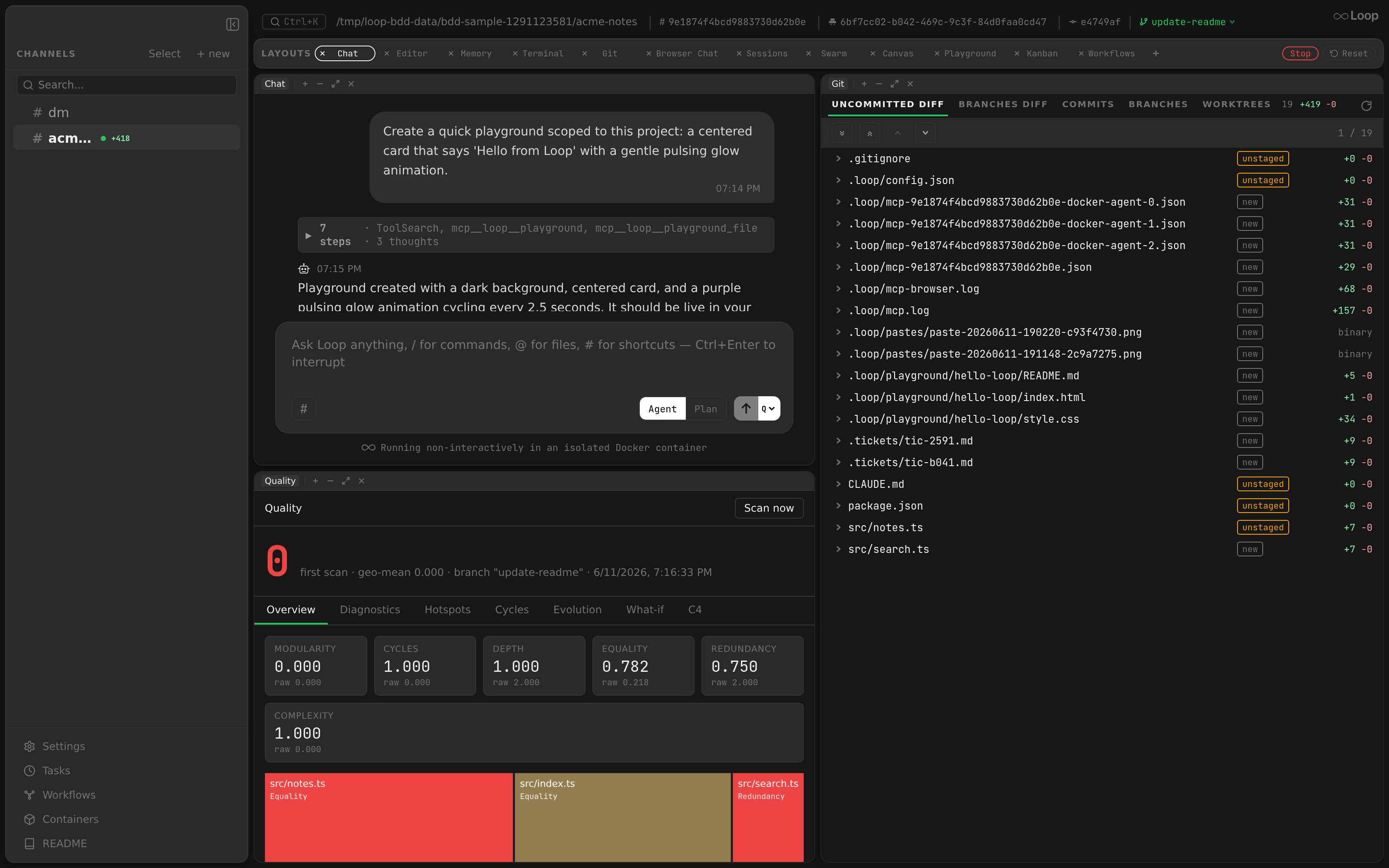
QualityPanel.tsx (app/src/components/panels/QualityPanel.tsx). Available as a per-channel split-pane panel; opens via the + panel switcher or the chat-bar quality indicator.
Layout, top to bottom:
- Headline — the absolute signal is the primary number (48px, band-coloured: red < 5000, amber 5000–7000, green > 7000). Once at least two scans exist for the current
(channel, branch)the change since the last scan rides alongside as a secondary chip prefixed withΔ(green for improvement, red for regression). On the first scan there is no chip — the absolute number stands alone. The underlyingprevious_signalfield is also exposed on thequality.scannedevent payload so consumers can render the delta without re-fetching the snapshot. - Tabs — Overview (metric cards + treemap), Diagnostics (per-tile breakdown), Hotspots (function-level complexity + clone clusters), Cycles (Tarjan SCC list), Evolution (git-history coupling, churn, bus-factor), What-if (mutation simulator), C4 (Mermaid).
- Metric cards — one per metric (Modularity, Cycles, Depth, Equality, Redundancy, Complexity) with current value.
- Treemap —
@visx/hierarchybinary treemap. Tile size = file LOC, tile color = per-file deficit (red = drag on signal, green = healthy). Clicking a tile selects it for the popover. - Diagnostic popover — opens when a tile is selected; shows path, LOC, top-reason metric, and per-metric deficit breakdown for that file (including complexity drag).
- Hotspots tab — worst-first complex functions with score, band-coloured severity, and per-dim breakdown (
cyc / cog / nest / params / LOC); plus collapsible clone-cluster cards listing each member function, total LOC, and worst pairwise Hamming distance. Both lists page via?limit=/?offset=. - Failed rules — citation cards for any failing rule.
Empty state (no snapshot ever scanned for this channel) renders a centered “Scan now” button plus a one-line explainer. Loading state during a scan dims the previous snapshot and shows Scanning… <done>/<total> driven by quality.scan_progress events (throttled to ~250 ms, with a guaranteed first and terminal tick).
The chat-bar quality indicator (app/src/components/chat/QualityIndicator.tsx) renders as a round dot in the input toolbar. Outline before the first scan; filled with the band color after. Clicking it adds a quality leaf to the channel’s split-pane tree (lands on the empty-state if no snapshot exists).
CLI
loop quality scan      [path]                    [--max-files <n>] [--json]
loop quality cycles    [path]                    [--max-files <n>] [--json]
loop quality whatif    [path] --file <muts.json> [--max-files <n>] [--json]
loop quality evolution [path] [--since-months N] [--max-commits N] [--json]
loop quality c4        [path]                    [--max-files <n>] [--json]
All subcommands run a one-shot scan of [path] (defaults to CWD). --json emits the same payload as the matching MCP tool / HTTP endpoint. Exit code 0 unless the engine itself crashes — rule pass/fail (for scan) is data in the output.
scan— full scan; prints the signal + metric breakdown.cycles— lists Tarjan SCCs > 1 file.whatif— reads a JSON mutation list ({op, path, new_module?, parts?}or array) from--file <path>(use-for stdin) and prints the predicted Δ signal.evolution—git logover the configured window (default 12 months / 1000 commits) for coupling, churn, and bus-factor signals. Requiresgiton PATH.c4— emits a Mermaidflowchartclustered by Go package (file directory), with top-level segments wrapped insubgraphblocks.
Useful for CI gates and ad-hoc inspection without running the daemon.
MCP tools
| Tool | Description |
|---|---|
quality_scan | Trigger a scan for the current channel. Returns a status hint immediately; the full report ships via the quality.scanned event. |
quality_snapshot | Read the persisted snapshot (current branch first, then most recent). Returns the signal, geo-mean, per-metric breakdown, and a branch-mismatch flag. |
quality_cycles | List Tarjan SCCs > 1 file from the current cached graph. |
quality_metrics | Per-metric raw values + scores from the latest snapshot. |
quality_diagnostics | Top-N file deficit attribution (god files, hotspots) drawn from the snapshot’s tile data. |
quality_rules | Pass/fail status for the built-in rules with structured citations. |
quality_whatif | Apply a list of mutations (delete, move, split) to a shadow graph and return the predicted Δ signal. The real graph is never touched. |
quality_evolution | Git-history coupling pairs, churn hotspots, and bus-factor risk over the configured window (default 12 months / 1000 commits). |
quality_c4 | Mermaid flowchart clustered by Go package, top-level dirs wrapped in subgraph blocks. |
quality_bugfactor | Files with the highest combined deficit + churn signal — best refactor candidates. |
quality_complexity | Per-function complexity hotspots (cyclomatic, cognitive, max nesting, params, LOC), worst-first, with offset/limit paging. Recomputes from the cached graph using the project’s complexity thresholds. |
quality_clones | Clone clusters from the cached graph (SimHash near-duplicate detection). Members, total LOC, worst pairwise Hamming distance per cluster, with offset/limit paging. |
All tools read channelID from the per-channel MCP server struct; they take no WorkDir argument.
HTTP
| Method | Endpoint | Description |
|---|---|---|
POST | /api/channels/{id}/quality/scan | Kick a scan asynchronously. Returns 202 Accepted with {"status": "started" | "in_progress"}. The full report follows over the events WebSocket. |
DELETE | /api/channels/{id}/quality/scan | Cancel an in-flight scan for the channel. Emits quality.scan_cancelled. 204 if a scan was running, 404 otherwise. |
GET | /api/channels/{id}/quality/snapshot | Fetch the persisted snapshot. 404 when no snapshot exists. |
GET | /api/channels/{id}/quality/cycles | Tarjan SCCs > 1 file from the current cached graph. |
GET | /api/channels/{id}/quality/metrics | Per-metric values + scores from the latest snapshot. |
GET | /api/channels/{id}/quality/diagnostics | Top-N file deficit attribution. Optional ?limit= (default 20). |
GET | /api/channels/{id}/quality/rules | Pass/fail rule citations. |
POST | /api/channels/{id}/quality/whatif | Apply a mutation list (request body) to a shadow graph and return the predicted Δ signal. |
GET | /api/channels/{id}/quality/evolution | Git-history coupling, churn, bus-factor. Optional ?since_months= and ?max_commits=. |
GET | /api/channels/{id}/quality/c4 | Mermaid flowchart for the current graph. |
GET | /api/channels/{id}/quality/bugfactor | Top refactor candidates by deficit + churn. Optional ?limit=. |
GET | /api/channels/{id}/quality/complexity | Per-function complexity hotspots. Optional ?limit= (default 50, max 100) and ?offset= (default 0). |
GET | /api/channels/{id}/quality/clones | Clone clusters from the cached graph. Optional ?limit= (default 25, max 50) and ?offset= (default 0). |
There is no auth — endpoints are intended for local Electron only, like every other /api/* route.
Events
All quality events use the standard 2-segment noun.verb format and are scoped to a channel_id.
| Event | Emitted | Payload |
|---|---|---|
quality.session_started | When a scan starts. | {dir_path, branch} |
quality.scanned | When a scan completes. | QualityScanReport (full payload — signal, metrics, tiles, rules). |
quality.rules_violated | When a scan completes with at least one failing rule. | {passed, failed} rule lists. |
quality.session_ended | When a scan returns (success or failure). | {branch, ok, error?, repo_too_large?} |
quality.scan_progress | Throttled (~250 ms) during a scan, plus a guaranteed first and terminal tick. | {done, total} |
quality.scan_cancelled | When DELETE /quality/scan cancels an in-flight scan. | {branch} |
See Events System for subscription details.
Triggering scans
There is no live-rescan loop. Scans run on demand:
- Panel — the per-channel Quality panel exposes a “Scan now” button.
- CLI —
loop quality scan [--json]from the workdir. - MCP — the agent calls the
quality_scantool (per-channel).
Repo-too-large guard
If, after applying built-in defaults + .gitignore + quality.exclude_paths, the remaining file count exceeds quality.max_files (default 25000), the engine refuses the scan and returns a structured RepoTooLargeError. The MCP tool, HTTP endpoint, and CLI surface this verbatim.
The cap is checked once at the start of file enumeration — no partial scan is produced. The panel’s empty-state banner asks the user to add patterns to quality.exclude_paths or raise quality.max_files.
Coalescing concurrent scans
The engine holds one in-flight cancel function per channel_id. A second quality_scan arriving while a scan is running returns {status: "in_progress"} immediately — no queue, no cancel-and-replace. The panel disables its “Scan now” button on quality.session_started and re-enables on quality.scanned / quality.session_ended / quality.scan_cancelled.
DELETE /api/channels/{id}/quality/scan invokes the cached cancel function — the engine returns context.Canceled, the daemon emits quality.scan_cancelled, and the partial state is discarded. Returns 404 if no scan is running.
Package layout
internal/quality/
├── doc.go                  # package overview
├── grammars.go             # active gotreesitter grammar pin
├── engine/                 # entry point: Scan() orchestrates parser→graph→metrics→snapshot
├── parser/                 # tree-sitter wrapper + .scm queries (go/ts/js)
│   └── queries/
├── graph/                  # file enumeration, .gitignore, dependency graph + cache
├── metrics/                # 5 metrics + signal aggregation + tile attribution
├── rules/                  # 3 built-in rules + per-rule config
├── snapshot/               # SQL-backed persistence (sql_store.go)
├── whatif/                 # shadow-graph mutation simulator + predicted Δ signal
├── evolution/              # git-log coupling / churn / bus-factor analysis
└── c4/                     # Mermaid flowchart emitter (Component layer)
Development
# Unit tests for the engine packages
go test ./internal/quality/...

# Local one-shot scan against the current repo
go run ./cmd/loop quality scan --root .
Coverage gate (make coverage-check) runs over the entire tree, including all of internal/quality/.... The parser package exposes a parser.Parser interface so unit tests run without invoking gotreesitter on every iteration.